

All-on-4 and All-on-6 implant treatment offers fixed teeth as an alternative to removable dentures for people with tooth loss or teeth that cannot be retained. At our Caddebostan clinic, we assess bone anatomy, oral condition and individual needs before planning care.
Contents
What Are All-on-4 and All-on-6?
These approaches support a fixed full-arch prosthesis on four or six implants in a jaw with no teeth or no retainable teeth. All-on-4 typically uses four implants; posterior implants may be angled to make use of available bone. All-on-6 uses six.
Both aim to provide fixed, functional teeth planned around jawbone anatomy and individual needs.
How Do All-on-4 and All-on-6 Differ?
The main difference is the number of supporting implants: four or six per jaw. Six is not automatically better for everyone, and four is not necessarily insufficient.
Bone and anatomy: implant numbers and positions depend on bone volume and quality, sinuses and nerve canals. Angled posterior implants in All-on-4 may use available bone and reduce the need for advanced surgery in suitable cases.
Force distribution: six implants may offer support across more implants where bone is suitable. Success also depends on positioning, prosthesis design, bone and oral care.
Timing and costs: differences are not always substantial. Both depend on individual needs, implant and prosthesis systems and additional procedures.
Our question is which plan best suits you. Examination and 3D imaging guide that decision.
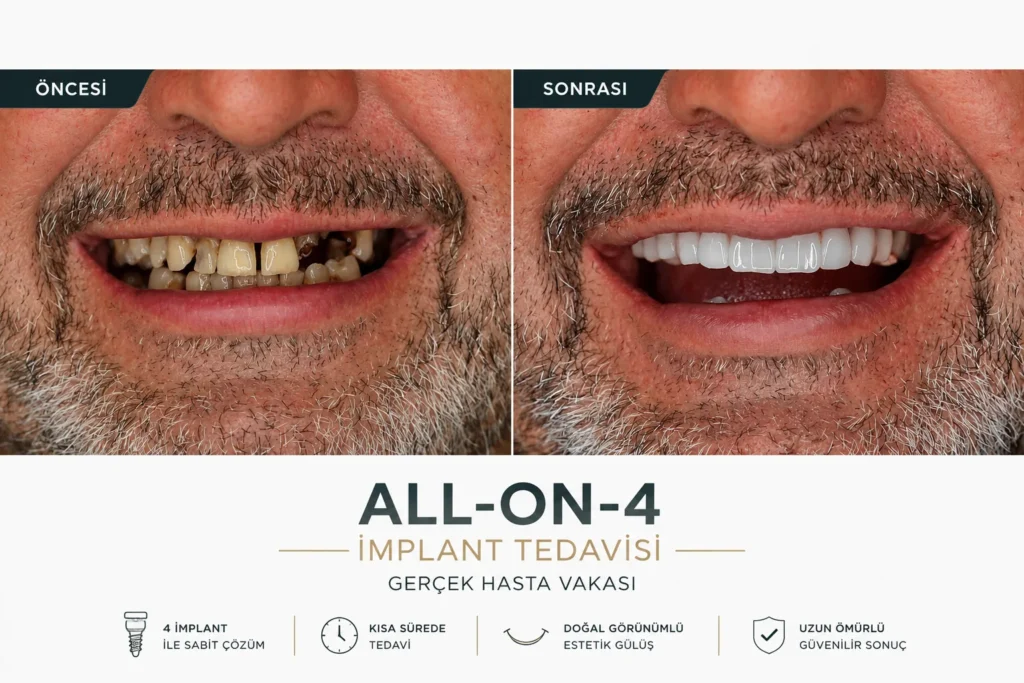
All-on-4 How Does Treatment Work?
- Assessment and planning: examination and 3D imaging assess bone volume, quality and anatomy to guide implant positions, numbers and prosthesis design.
- Placement: planned implants are usually placed in one surgical session under local anaesthetic. Additional options such as sedation may be considered when appropriate.
- Temporary fixed teeth: adequate initial implant stability and suitable clinical conditions may allow a temporary fixed prosthesis on the same day or shortly afterwards. Immediate loading is not suitable for everyone.
- Healing: integration with bone commonly takes around 3–6 months, depending on bone, surgery and individual healing.
- Final prosthesis: after healing, fixed teeth are made according to oral anatomy, function and aesthetic expectations.
All-on-4 and All-on-6 Who May Be Suitable?
- These treatments may be considered for:
- People who have lost all teeth or whose remaining teeth cannot be retained;
- People with extensive tooth loss whose remaining teeth cannot support a fixed prosthesis;
- People who do not want removable dentures or are dissatisfied with them;
- People with bone loss who still have suitable bone for implant placement.
- Numbers and methods are individually planned after examination, 3D imaging and assessment of bone and general health.
Our Priority: Preserving Your Natural Teeth
Full-arch treatment is considered when removal of all remaining teeth is genuinely necessary. Our priority is to preserve natural teeth whenever possible.
We first assess whether periodontal, restorative or endodontic care can retain existing teeth. Implants are not a routine substitute for retainable teeth. Preserving natural teeth wherever possible is a central principle of modern dentistry.
Our Approach to Treatment Planning
Our clinical experience includes advanced implant surgery and full-arch fixed prostheses. Planning considers bone anatomy, implant position, long-term prosthesis function and ongoing care together.
At our Caddebostan clinic, examination and 3D imaging guide each plan. We avoid unnecessary implants and extraction of teeth that can be saved.
Frequently Asked Questions
Book an Appointment
Contact us to arrange an initial assessment and find out whether All-on-4 or All-on-6 may suit you.